


Paul Degnan
Local writer and storyteller, George Murphy interviews local characters and personalities. More HebWeb interviews
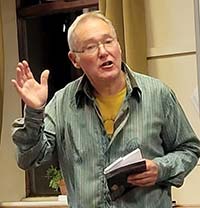 Introduction
The latest interview focuses on Old Town resident, Paul Degnan.
Discover why he left home at an early age, his part in the 70s hippy invasion of Hebden Bridge, how he became a shop owner, social worker, storyteller and writer…
…and why he stares at ancient stones.
Paul Degnan answers George Murphy's questions
Paul, can you tell us about your family, early years and school days?
I was born in Luton in 1953 the youngest of three children. My sister and brother were 7 years and 5 years older respectively, so I was the afterthought from Dad coming home from Korea. During Mum's pregnancy they thought she was having twins and then I popped out 11 pounds in weight! The midwife said I needed a lamb chop rather than a teat!
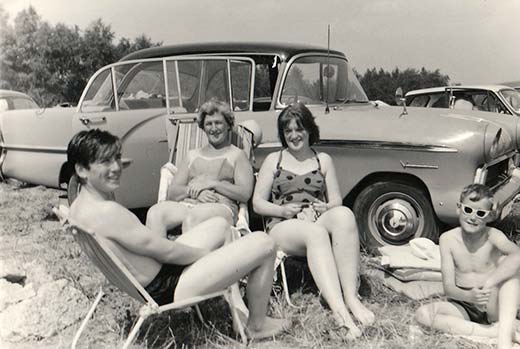
Photo: Family photo 1960 with Vauxhall Victor.
Paul is on the right with the groovy sun glasses!
Dad was an Army career man, serving abroad in Kenya and Korea in the early 1950's, so I was raised in my formative years by Mum and Grandma. When Dad returned home to meet me for the first time I said, "Who's he?" This didn't go down well.
Although Dad was strict and institutionalised by Army life, Mum counterbalanced by being nurturing and caring, so I had a stable upbringing living in the same terraced family house in the suburbs of Luton until I left home at 16.
Our housing estate on the north perimeter of the town was built post-war and was surrounded on three sides by corn fields, woods and a large recreational park, so playing outdoors was commonplace.
I went to the local junior and infant school and due to failing my eleven plus I went to the local secondary modern. This was a blessing to me because all my mates failed too, so established friendships continued. The downside was that I didn't get the reward of a bicycle like my brother and sister received for passing the exam!
You were a teenager in the 60s. How did the changes in music and culture affect you?
I was fourteen in 1967 when Scott Mckenzie sang "San Francisco" and the iconic Beatles Sgt Pepper's Lonely Hearts Club Band album was released. However, it was in 1959 when Dad brought home a Dancette Record Player, and the music of the day became part of the family culture.
My older sister was a big Elvis fan, my brother a mod while Mum loved the early Beatles hits. I had my very own Transistor Radio in 1968, listening to the Beach Boys, Tamla Motown and Top Ten hits down the park in the long hot summer holidays. Later I would tune into Pirate Radio stations and listen to the John Peel Show, an assortment of folk, blues, psychedelic and progressive rock music. There was such a wide variety of creative music emerging back then that influenced me and helped me question and challenge the status quo.
You had a difficult relationship with your father?
Dad came from an Army family and was put in Army boarding school from the age of 8 so he didn't have a family life of his own. He attained the rank of Sargeant Major, so life at home with him was regimented and strict. For example, if I wanted to go out in the evening, I would knock on the living room door and say I was off out, and he would reply "Be in at nine or else!"
He was all those things you don't want to see in a father – a bully, a racist and a bigot. He didn't share his feelings, and he didn't talk about the war. Due to his attitude, we three children left home as soon as we could. My sister went to America to be an Au Pair girl, my brother joined the Army and I grew my hair long, which didn't go down too well...
How old were you when you left home? Did you stay with friends?
I was 16. Dad and I had a big bust up and off I went into the night, sleeping in the local laundry! Initially, I stayed with friends and then rented a bedsit in Luton town centre. This is when I met like-minded young people that became the local hippy scene. Part of this was travelling to free festivals at Shepton Mallet and the Isle of Wight. It felt like we were on the crest of a wave, a new movement (a counterculture) to bring about positive changes in society. Wherever you went, if you had long hair you were part of the tribe and you helped each other. I remember travelling to the Isle of Wight in 1970 to see Hendrix, Joan Biaz and Leonard Cohen and doing the peace sign every time I saw a fellow hippy. Love and Peace was the call sign.
It was the cold war and we were living with the real threat of a nuclear war hanging over us. There were predictions that the world would end in 1975 or 1984. The hippy movement and the anti-war peace movement were entwined and there was that sense of empowerment that we could do better than our parent's generation.
Back in Luton a small group of us established a commune and we had dreams of living in the country and growing our own food. When Marc Bolan performed in Luton in 1971, I went backstage after the gig with a mate to ask him for a donation to help finance our dream. Needless to say, he gave us short shrift!
Still in your teens, you became a father. What was being a single parent like?
My son was born in late 1972. The Luton 'hippy scene' had imploded by then and there were lots of fallout. I was still following the dream of living in the country and when my son's mother became pregnant. We tried to find somewhere but ended up living with the same crowd in Luton.
Unfortunately, my wife couldn't manage a baby and wanted to stay in the same scene. One of my mates had moved to Cragg Vale and invited me and my son to join him, so in March 1973 we moved to the Calder Valley.
Bringing up a 3-month-old baby was difficult, but I got on with it and managed. I remember carrying him around in a Papoose and all the old ladies on the Cragg Vale bus would coo and feel sorry for him. They would offer him sweets, but I would decline saying they weren't good for him, much to their disapproval.
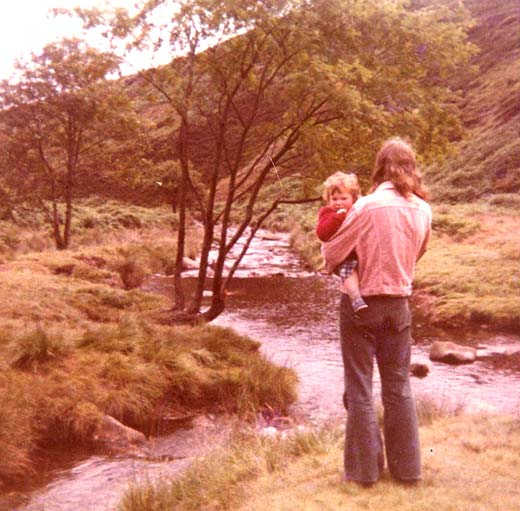
Photo: Blake Dean 1974
I met lots of local hippies in Hebden Bridge who were in similar circumstances, and this helped - knowing I wasn't on my own. Being a single parent father was very rare back then. I went hitchhiking with him when he was 18 months old and was stopped by the police; they thought I had kidnapped him!
You were known as one of the Hebden Bridge Hippies. Did you take part in community actions, such as squatting?
I moved into renting my own house on Queens Terrace with the help of a local friend after 6 months, and this helped because the bottom end houses of the terrace were squatted by many likeminded young people, who had moved to the area and this 'community' provided much needed social support. From this group we formed a local creche based at Pitt Street Education Centre to look after our pre-school age children with parents taking turns on a rota system.
Can you tell us about your role at the Aurora shop on Market Street? Was it frequented by locals as well as by offcumdens?
Running the local Wholefood shop fell into my hands. Post Luton I had flirted with Veganism and then became a Vegetarian, embracing a healthier lifestyle. I bought into the philosophy that "you are what you eat" and that "your body is a temple" and I found this to have a positive effect physically and mentally.
In 1974 the new "hippy shop" on Market Street, originally called "Sun, Moon and Herbs" sold handmade crafts 'sale or return.' It was run by a couple of laid-back hippies who opened up when they felt like it. I called in one day and offered to help out and the following week I got a knock on the door to ask if I could help out on Saturdays. From this, the two hippy blokes dropped out and I took over the reins of the shop and turned it into a Wholefood shop. When the shop takings were stolen, I set the shop up as a business and called her Aurora.
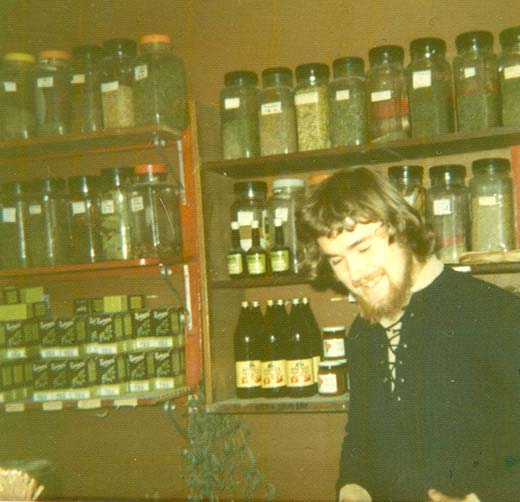
Paul, working at Aurora Wholefoods
The shop was one of many springing up at that time in England working on the philosophy of bagging up your own food and liquids by using recycled bags and glass / plastic containers. We bought bulk wholefoods from various suppliers and sold on in smaller quantities. I ran the shop for two years and in that time it developed into a community shop thriving on a growing 'alternative' community, increased use of volunteers and a hub for advertising local events and selling related literature. Many local people would shop for specific items like herbs and spices that they couldn't obtain elsewhere but in the main to local people it was the 'Hippy Shop.'
When did you decide to leave Aurora? I think you spent some time in Gloucestershire?
Two years running a shop indoors in the summer months was hard even though I was working in my ideal job. An opportunity came along to work on an Outdoor Activity Centre in Gloucestershire for City Kids. I left Aurora in good hands, passing it on to a newly formed Workers' Co-operative and moved down to the site with my girlfriend; a place called Macaroni Woods!
The job didn't work out as described but I stayed in the area, living off grid in a caravan for three years working on an organic garden. We cycled everywhere, kept chickens and a goat called Gypsy, and made some good friends. In the end my friends moved on and we became socially isolated so I returned to Hebden Bridge via Manchester.
Eventually, you had a career change and became a Social Worker. Did you do a course whilst you were still working?
On my return to Hebden I met my second wife at a Ceilidh in Mytholmroyd and we lived together in Old Town before we bought our first house on Windsor Road. I was a 'jack of all trades' back then, getting work where I could; we did the market circuits selling homemade cakes and wholefoods, and I did various landscape gardening and painting and decorating jobs.
I also undertook volunteer work with young offenders in Halifax. It was this and my single parent experience that opened the door for me to enrol on a Diploma in Social Work course at Huddersfield Polytechnic. This was a mature students course and they had lowered the age threshold from 30 to 25years so I think I was the youngest on the course that year in 1981.
As a Social Worker you got a regular wage, and your family size increased. Can you tell us about those years and your children and grandchildren?
I qualified in 1983 and started as a fledgling social worker in Calderdale. Social work was a vocation to me; I wanted to help people and wanted to make a difference. The course attracted me because I wanted to study psychology and sociology; how people ticked and how society impacted on their lives. In the 1980s, community social work was in its vogue and as a worker you could connect people with local support networks to get the help they needed. Work was rewarding and engaging.
I remarried the same year I qualified and in the course of time two lovely daughters were added to the family. We settled down to family life and the routine of work to make ends meet. Now my three children have flown the nest and I have been blessed with five grandchildren all living in the Upper Valley.
Social Workers have a tough job. Did you find it satisfying?
When the new Community Care Act rolled out in 1993 I changed over to Adult Care to work mainly with older people. This in itself was rewarding because instead of being insulted by young adolescents I was being thanked by older people who were appreciative of my assistance! What I found interesting was that older people loved talking about their life experiences. This opened my eyes away from the stereotypical societal view of old age to an understanding of what our elders can offer us.
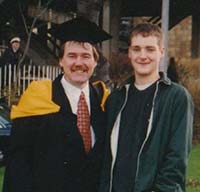 I undertook an MA in Social Work in 1995 at Bradford University to study Gerontology and research Life Story work. My dissertation was a narrative study on the Life Story of a couple of residents at a local Care Home to which I gained a distinction. My career took off at this stage and I obtained several secondments in development work and in training, rolling out government initiatives in Adult Services in Calderdale.
This interest paved the way for my interest in storytelling as a medium to share human stories. I think if we listen to a person's story we then have an understanding of who they are and where they're coming from, This is a great leveller and a powerful game changer.
We'll take a pause. Some questions sent in by HebWeb readers:
What are your favourite:
Books: There are many but The Old Ways by Robert McFarlane stands out.
Films: Again, there are many but Himalaya by Eric Vallis is up there.
Box Sets: Recently it's got to be "The Night Manager." Nostalgia – Star Wars and Indiana Jones.
Types of music: Folk Rock / Indie Rock
Holiday locations: The West Coast of Scotland / Inner and Outer Hebrides.
You were one of the founding members of The Shaggy Dog Storytellers at Stubbing Wharf. What attracted you to sharing and hearing folktales?
I think it was 1995 when I attended a storytelling workshop at the Stubbing Wharf run by Alan Sparkes and Roy Dyson. Alan ran a storytelling club in Manchester and was starting one in Hebden Bridge. Storytelling as a Performing Art was undergoing a revival nationwide at that time so I joined in at an exciting time and benefitted by listening to the great tellers of the time, like Ben Haggerty, Hugh Lupton, and Jan Blake.
With Christine my partner, and Rachel Loise we joined with Alan in helping to run the club on a regular monthly Friday night spot. The Club gained in popularity and overfilled the upstairs room of the Stubbing Wharf Pub many times over. At its height in the late 1990's and early noughties it gained the reputation of being the best storytelling clubs in the north of England.
My interest in folk tales developed in tandem with my own development as a storyteller. Joseph Cambell's book "The Hero with a Thousand Faces" had a big impact on me at the time. His idea that myths are "stories about the wisdom of life" rang true. I researched many folk tales, myths and legends from around the world and found them to be alive with stories about the human condition.
My main study area evolved into a passion about British Mythology particularly from the Celtic fringe. The Four Branches of the Mabinogi became a firm favourite, a series of tales written down in medieval Wales deriving from older myths about the Welsh pantheon of Gods.
Covid and Lockdown had a devastating effect on the UK storytelling community, from which it is starting to recover. Looking back, what have been some of the highlights in watching great storytelling at Shaggy Dog and elsewhere?
Shaggy Dog enhanced its reputation by inviting some of the best British Tellers of the time including High Lupton, Ben Haggerty and Robin Williamson and Irish tellers Eddie Lenihan and Liz Weir. In addition, it gave the opportunity for new talented up and coming tellers to perform, for example, Nick Hennessey, Katy Caukwell and June Peters. One stand-out performance was when Hugh Lupton and Daniel Morden showcased their rendition of The Odyssey in the Little Theatre at the Hebden Bridge Arts Festival one year.
Many club exchange evenings occurred with clubs in Manchester, Newcastle and Sheffield; this provided a platform for local storytellers to gain experience. But the icing on the cake was attending the two major annual Storytelling Festivals. Beyond the Border International Storytelling Festival in South Wales, in its heyday in the late 1990s to early noughties attracted traditional storytellers from varied cultures around the world. Highlights included Inuit throat singers, Chirgilchan, a group of Tuvan Mountain throat singers and Gayle Ross a Cherokee storyteller.
Unfortunately, cuts in Arts Funding Grants limited its repertoire but I believe it still continues bi-annually. Festival at the Edge in Shropshire was a smaller volunteer led hearth-based storytelling event attracting many people linked to the British storytelling network. This festival is still going.
You live in Old Town and enjoy walking on the tops. How much was your book of stories A Backward Glance (2021) inspired by your walks?
I've always had a big passion for getting out into nature. This likely stems from hearing my grandmother's tales about her early life in rural Bedfordshire. I did a lot of walking after my divorce in 1994, and going to the Lakes for regular hikes up the fells with some mates was breathtaking.
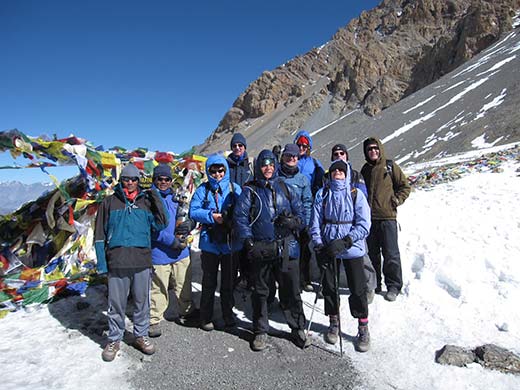
Nepal Trek 2009 - Thorang La mountain pass Annapurna
Trekking in Nepal in 2009 and the Atlas Mountains in 2011 were two stand-out experiences in my life. A love and study of local flora and fauna developed as teenager. I loved to walk out and identify wildflowers and write them down. I still do this when I'm somewhere new. Richard Mabey's book "Food for Free" was the bible back then for foraging. When I started writing I had strong images from my own experience of walking in the landscape to draw upon for my stories.
When I retired in 2013 I attended a WEA Creative Writing Group where over time I wrote a few short stories that were well received by the group. There's a view in the storytelling world that the stories we choose to tell have personal meaning to us and this was true in writing short stories. I drew upon a range of personal experiences, some based in the local landscape as a canvas for my short story collection. This evolved during COVID when in social isolation I had the time to put pen to paper and write enough material to self-publish "Backward Glance."
I surprised myself by discovering that a lot of the stories I wrote had the theme of loss in evidence. The writing process can be cathartic. Self-publishing is very rewarding and I'm now toying with the idea of a second volume.
You visit lots of ancient monuments on your travels. Can you explain what motivates you to visit ancient sites and recognise seasonal dates in the pagan calendar?
My journey has touched upon and been influenced by some of the grand narratives of the major world religions, but what I've found and feel comfortable with is the sacredness of Mother Earth. Probably, it was my first visit to Glastonbury and then Stonehenge back in 1972 that impressed upon me that these ancient sites were special. My interest in Megalithic sites stems from those early pilgrimages I made. In Hebden Bridge in the 1970s, I was part of a group we called "The Old Straight Track Club," influenced by the famous antiquarian Alfred Watkins. We would set off to explore local historical sites in a mate's beaten-up Land Rover. It was a bumpy ride! This same group was the inspiration for setting up Peace Vigils in the local landscape in that decade, in the face of the threat of nuclear war during the Cold War.
When I'm out walking in the landscape I'm connecting with all the elements and I'm finding something bigger than myself. We are lucky in Britain that we have a plethora of megalithic sites that were built by neolithic and bronze age people who in that moment of history maintained a spiritual connection with the natural world and through necessity developed an agricultural calendar to be in tune with the seasons to enhance survival.
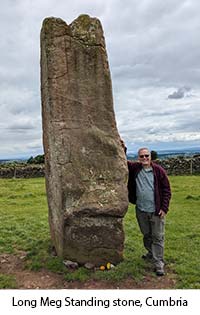 Visiting ancient sites, where it is likely that these 'ceremonial' seasonal activities occurred, gives me a sense of connecting with our indigenous ancestors. We have no written records of what our ancestors thought or what their motivations were, but the living record is there in the stone monuments.
In retirement I organise an annual summer trip to visit areas of the UK where there is a concentration of megalithic sites. This is under the umbrella of 'Northern Earth' with an established group of long-standing friends. This year we're going to Aberdeenshire where there are a number of recumbent stone circles.
My kids laugh at me when I return and show them 50 photos filmed from different angles of a stone circle or a dolmen.
"Dad not another picture of a stone!"
Finally Paul, is there a question you would like me to have asked?
You didn't ask about CROWS …
Yes CROWS – Community Rights of Way Service! I've been a volunteer for what seems a lifetime but it's probably my ninth year. I go out once a week on a Wednesday with a colleague or a team of folk to help repair / maintain local footpaths in the Upper Valley. It keeps me fit, I'm working outside and its rewarding work.
So, on that note here's a wee CROWS story to end my interview.
Ginny (another volunteer) and I were working on the Calderdale Way above Mount Skip Golf Club. At the time, my son was one of the Greenkeepers at the Golf Course and he gave us permission beforehand to park near the Club house, so we only had a short distance to carry the tools and materials to the job site. We arrived about 9-30am and were putting our boots on when a voice shouted over to us from a nearby parked car.
"You can't park here!"
We looked over and there was this old guy with a broad Yorkshire accent walking toward us with a disapproving look on his face. I explained that we were CROWS volunteers and that we had my son's permission to park here.
"Who's your son then," he said.
"Deggy" I replied.
"Never heard of him!"
And then fortunately his companion confirmed that he knew Deggy, but the old guy carried on.
"Anyway," he said, "You're not from round here are you?"
"Well," I replied, "I've lived here for 50 years and my three children were born here, does that not make me a local?"
"Nah" he said, "Not 'til you're in the ground!"
More HebWeb interviews from George Murphy
If you would like to send a message about this interview or suggest ideas for further interviews, please email George Murphy