


Sixth series, episode 4
All six series are available here on the HebWeb.
In this episode, George Murphy shares reels from celebrities he admires, discusses the fallout from the war in Iran, explains an unexpected change in women's cosmetics triggered by a recent film and celebrates the Hebden Bridge Film Festival. He is moved and impressed by a poet, hears from witnesses of thefts from local stores, celebrates the unheralded rise in renewable energy sources in the UK and sings about the love life of a Schools Inspector.
Scrolling, just scrolling …
Professor Brian Cox: 'The hydrogen in your water is from the Big Bang, The carbon in your DNA was forged in a star. The iron in your blood came from a massive supernova explosion. You aren't just living in the universe – you are the universe, recycled!'
Comedian Mark Steel: 'Just to make things clear: two countries with nuclear weapons are bombing a country without nuclear weapons and all the countries of the world should support the bombing as it is the only way to unblock a part of the sea that wasn't blocked before the bombing started.'
Mathematician Professor Hannah Fry (demonstrating how to open a sealed jam jar) 'Trying to open a sealed jar with the strength in your hands and wrists is where you might have been going wrong. Instead, fill your lungs with air and just as you blow out the air your diaphragm muscles will enable you to open it.'
Which she did.
Result: after three quarters of a century of failure, I opened my raspberry flavoured, sealed jam jar first time without pouring hot water on it or – back in the old days – levering it open with the hinge from our heavy backdoor.
Trump cards
Trump and Netanyahu's war on Iran, not only led to a boom in oil prices, the deaths of two thousand citizens and fright flights out of Dubai by holiday makers and expats, but also caused unexpected electoral gains for Social Democrats. In Spanish local elections right wing parties failed to make their expected gains. In the major cities of southern France, the National Rally failed to capture major cities in the southern region. In Italy, Trump ally Georgia Meloni failed in a referendum to reform the judiciary, which she said "befriended immigrants, rapists, paedophiles and drug dealers." At home, Andrew Neil in The Daily Mail reckoned, 'Trump has made his biggest mistake'.
Brontë blusher
Following my recent report on the film, I was interested to see The Times report that fans of the latest Wuthering Heights film are crazy for the rosy cheeked, 'just-been-wuthered,' glow of Catherine Earnshaw, after the make-up artist revealed that Margot Robbie wore Chanel 1 Lip & Cheek Balm. Sales rocketed by more than 5000 percent.
Notes on our Film Festival
The theme for this year's festival was 'Bearing Witness'.
Landmarks, directed by Lucretia Martel, was introduced by our adopted Italo-Argentinian screenwriter Agustina Figueras, who reminded us that her country is currently led by a Trump following, chainsaw toting far right President.
Martel uses footage documenting the murder of indigenous activist Javier Chocobar of the Chuchagasta community. The killer, his accomplices, mining corporation lawyers and a mocking propagandist historian were so openly contemptuous of the indigenous people that if this film been fiction you'd accuse them of gross overacting.
Fortunately, the subsequent court case included testimony by a university professor who provided documentary evidence the original community had painstakingly gathered ever since the Spanish invasion.
Chocobar's killers were found guilty, and given long sentences, but … just as the audience cheered (our festival audiences like to share their emotions) … subtitles showed that the men were pardoned two years later, by yet another in a long line of corrupt, gaucho hating Presidents.
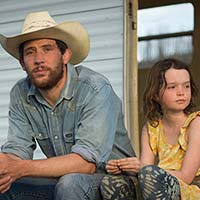 Rebuilding, directed by Max Walker-Silverman, included Brit Josh O'Connor (Prince Charles in The Crown) with Australian schoolgirl actress Lily May Torres as his daughter. Both leads nailed down the South Colorado accent. As in the Chilean film, the Colorado scenery was immense and beautiful, but this time the plight of O'Connor and his family was caused by forest fire. So it flagged up the effects of global warming. I particularly liked the scene where the laconic dad sorted through photos of generations of his family who had lived at his ranch before it burnt down as a legacy for his daughter.
After the film and comfort break (supping tea from mugs and quaffing red wine from plastic beakers being a HB tradition), festival director Louise Wadley pressed a button and a giant Lily, and massive Max appeared in split screen to answer questions. Louise chatted with her young, confident compatriot, who said that her favourite scene was pasting star stickers all over the inside of their temporary home, turning the lights off, pulling the blinds down, and revealing stars of light which was "pretty awesome".
I liked Max's explanation for refusing to use a typically dramatic plotline. He thought most people just muddle through with their neighbours, especially at times of adversity. To add to a sense of social realism, he chose some locals for roles, their lived in faces being more authentic looking than those of the skilled, professional actors.
I wanted to watch The Blue Trail at The Trades club, a near-future feature, in which 'older people are put away in colonies as the government gives priority to younger generations,' as I might have learnt how to avoid Gen Z kids who might crave our triple locked incomes and houses.
But, as I once lived next door to an Acre Mill mesothelioma victim, and I've interviewed John Pickering, the Hebden Bridge solicitor who fought to get compensation for asbestos sufferers, I felt a responsibility to watch Yurlu Country, a documentary by Yaara Bou Melham about blue asbestos. It was a good choice. Yorlu won the festival award for best documentary.
In the Q&A, Yara Bou appeared in a Geneva hotel room, following a successful launch of her film, apologising for not appearing in person due to the difficulty of getting safe flights during the Iran war.
Yara explained that she wasn't sure how to approach her subject at first, as there are over 60,000 mines in the country. The asbestos ones have not been cleansed after the mining companies moved on. Fortunately, she met former ranger Maitland Parker, who was dying of cancer despite never having been an asbestos miner and she decided to follow his story. Louise explained that as an Aborigine Elder, Maitland would normally have respected local Banjima tradition and would have thought long and hard before deciding to take part in the filming.
Melham realised that stories - fictional or factual - are often best told by focusing on family sized leading characters and Maitland was a very impressive participant. He died during filming. Since the film was released in Australia, it has generated a powerful reaction – the failure to compensate indigenous communities and to clear up toxic waste was akin to our ITV series about the Sub Postmaster scandal.
Broken English, directed by Iain Forsyth and Jane Pollard has received lots of thoughtful, commendatory reviews. Here's my own list of
Things I liked:
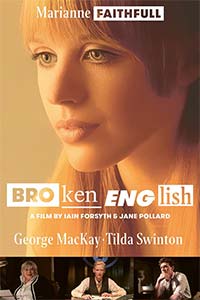 Marianne Faithful's advice to students on a writing course: be dogged, write last thing at night and first thing in the morning;
 - The clips revealing her brilliant, though acid fuelled, stage performance as Ophelia in the mad scene;
- Recordings of post 60s gigs, alongside younger musicians and singers;
- Learning that Marianne wrote Sister Morphine with Mick Jagger. Her solo version was withdrawn by her record company, whilst The Stones used their version on Sticky Fingers;
- Glimpses of her Pirate Jenny in The Threepenny Opera;
- George McKay's sympathetic and supportive questions and her unrehearsed responses.
- She learnt after his death that her dad had kept a scrapbook of the headlines and articles she attracted throughout her career;
- Uncovering the misogyny of 60s society, typified by the police's made up Mars bar story.
- Witnessing her singing Misunderstanding, with Nick Cave and Warren Ellis. A heartbreaking for us, but joyous for her, final performance.
Keyboard player, Ed Harcourt changed trains four times in order to share his memories of Marianne. In response to a question from a cineaste in the audience, he admitted that he "didn't know what the fuck was going on during the film making." He said, Marianne swore like a trooper and sent him a postcard shortly before she died, saying, "If you'd been born 20 years earlier, I'd have had you!"
Calle Malaga, directed by Maryam Touzani, won the audience award at the Venice film festival, and, roll of drums: was my vote as the best feature film in our festival! Simply, it had the best storytelling and I needed laughter after the compelling but heart wrenching documentaries. Carmen Mura ( 'Almodovar's muse') plays Maria Angeles, a 79 year old widow who loves her life and friendships in Tangier. But her happiness is turned upside down when her daughter sells the apartment where she has always lived. How Maria manages to repossess her home and her possessions and find new love is an uproarious and consistently surprising tale.
There should also be a special award for nun Josefa (Maria Alfonsa Rosso) who had sworn a lifelong vow of silence, but managed to raise the loudest laughter of the festival in her reactions to Maria's explicit descriptions of her new lover's lovemaking.
The Short Film Competition has become an audience favourite, and the Picture House was packed. Several rows at the front were reserved for new directors, actors, animators and screenwriters, including locals who had been coached for a short course by Louise Wadley.
I voted for the documentary How fast can you eat a pickled egg, directed by Daniel England, but was delighted when the main prize in the jury and the audience categories went to a young local animator and director, Laura Jayne Hodkin in her 3 minute tale of emo teen, Helena's 'turbulent journey of love' in Wuthering Hearts. In her acceptance speech, Laura said she was inspired by memories of her broken hearts during brief teenage romances and she said she liked to make people laugh.
(Louise Wadley and Agustina Figueras have both been featured in The HebWeb Interview.)
Others Day
I was impressed by Kathryn Millington, the visiting poet at Todmorden's monthly Gobsh!te gathering at The Golden Lion in Todmorden, but not just because of her poems. She read from her Imprint pamphlet on the grief suffered by couples as a result of involuntary childlessness. One poem was called For the Others, on Mother's Day. The 'others' being women suffering unwanted childlessness, a fate suffered by one in five women in the UK.
Kathryn pleaded with us not to ask, "Why don't you adopt?"
Although, she was glad that many couples find happiness through adoption, like most people, she wanted to experience giving birth to the pooled genes of herself and her husband.
"If my dad died, would you have asked me, 'Why don't you adopt another dad?!'"
On the cover of her pamphlet, I read the comments from other poets. She had sent her draft pamphlet to Benjamin Zephania, after reading his laments for not having his own children. He responded: "I am lost for words, because you said them all."
Stealing from stores
In a large store in the valley, a man in dark clothing with an earflap hat noisily threw packets of steaks into a wheelie basket and then calmly walked out without paying. My source, who I can vouch for, urgently alerted a young guy who was filling the shelves. He replied, "Oh … you mean … he's a shoplifter? … Well, I'll have to tell my supervisor."
Instead of chasing after the thief, he strolled off to tell his boss.
Meanwhile, in another store, a different witness tells me it happens all the time, but she feels pity for shoplifters who are so desperate that they have to steal food. I mention that the chain store is selling petrol for more than £1.52 per gallon, but another of its petrol stations just down the road is charging £1.56 …
Heated debate
While some are arguing for increasing expenditure on oil and gas and for cuts in the green levy, the National Grid published results showing that for the last five years, the four main renewable energy sources used to power the UK, wind, solar, hydroelectric and bioenergy, have contributed more than half our energy needs. At the turn of the century, renewables provided 2 percent of our energy needs. Now they provides 51 percent. The trend is expected to increase and there has been a surge in sales of solar panels since the government copied the German approach of selling cheap, plug in solar panels.
And Finally …
I got a request to perform this tale from a fellow monologue performer at the Shaggy Dog club. It recalls when Ofsted ruled that a satisfactory grade really meant must improve!
I wondered how this stipulation would work in other parts of our lives …
Murphy's Lore, the book, is available to order here
If you would like to send a message about this piece or suggest ideas, email George Murphy
More Murphy's Lore
See the Murphy's Lore home page for over 160 episodes.