

Thursday, 20 November 2025
Hebden Bridge Local History Society Report
Archeologists to take advantage of the
flood alleviation sceme
Speaker: Stephen Dean
First, an admission: this wasn't the advertised talk of two halves. Stephen Dean, Senior Archaeologist with the Environment Agency, had so much to explain at the meeting of Hebden Bridge Local History Society, that the glitter of the Staffordshire Hoard was squeezed out by the potential for rather greyer discoveries on our doorstep.
The Hebden Bridge Flood Alleviation scheme has not yet received planning permission, but already the archaeologists are doing preliminary surveys and identifying areas of interest.
Steve was keen to make links with local historians to draw on their knowledge and to see what questions they would like answers to. Archaeology in an urban setting is obviously constrained by existing buildings and by the necessity to preserve the heritage assets of the town.
Maps identifying the areas of interest and historic value will form part of the planning for the flood alleviation work. The river is part of the town's identity, and even the sounds of the water over the weirs can be seen as part of the heritage.
The packhorse bridge that gives Hebden Bridge its name is a major focus for potential investigation. The bridge has the protection of being a scheduled monument dating back to 16th century, but repairs and rebuilding over time means that its extent is not entirely clear. The chance to dig into its buried past may reveal evidence of the life around this important river crossing in earlier centuries. There was a manorial corn mill on this site which hasn't been definitively located and suggestions that there might also have been a smithy and possibly a tannery close by.
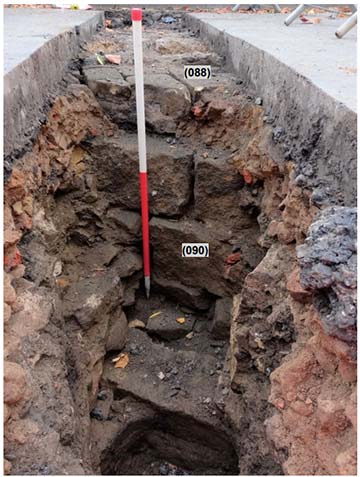
Archaeologists like to dig, of course, and small trial pits in Old Gate and the St Pols car park have uncovered different building materials such as hand made bricks, and large flags implying floors below the current ground level. There is nothing glittering hidden here, but to an archaeologist there is significance in the use of lime mortar and the laying of stone sets and slabs – these were buildings that were meant to last, evidence of a settled population. Things will start to get more exciting when finds emerge which are connected with everyday life. Items such as stoneware or porcelain can provide dating evidence and fill in the details of the town's story. Rubbish dumps provide some of the richest resources.
The Environment Agency archaeologists work to a strict protocol aimed at protecting the built and buried heritage. As well as working on small below ground sites, they have a watching brief to monitor the work as it progresses.
If planning permission is successful the first phase of archaeological research should begin in June 2026 with interim reports made available. Steve hopes that there will be some community involvement uncovering new stories and answering old questions about the history of Hebden Bridge.
We were left with some tantalizing pictures of the gold in the hoard uncovered when Steve was County Archaeologist in Staffordshire. He promises to return next season to complete the planned second half of his lecture and to share his thoughts about the people who made and used these highly decorative objects.
Hebden Bridge Local History Society meets from September until April on the second and fourth Wednesday of the month at Hebden Royd Methodist Church, starting at 7.30 pm. Details of the History Society talks programme, publications and of archive opening times are available on the "What's on" section of the HebWeb, on the History website and you can also follow the History Society Facebook page.
With thanks to Sheila Graham for this report
See previous reports in the HebWeb History section