

Thursday, 5 March 2026
Hebden Bridge Local History Society Report
Wainstalls Waifs
Speaker: Kim Pearson
Kim Pearson has been researching the history of the child workers at Wainstalls Mills for more than twenty years. They were known as the Wainstalls Waifs, a name that conjures up the worst of Victorian squalor and exploitation.
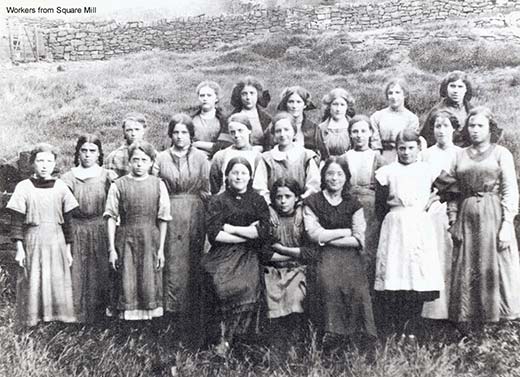
Photo: Workers from Square Mill
Kim told Hebden Bridge Local History Society how the story first caught her imagination when she came across the so-called Orphans' Grave in Luddenden Dean which records seven girls who died there. Inevitably there were horror stories about the cause of the deaths – was it an industrial accident or shameful exploitation? In fact it was neither, and far from hiding a scandalous tragedy, mill owner Jonathan Calvert paid for and put up the memorial stone.
So the story that Kim discovered as she searched the written records and talked to people in the village, was one with happier endings. Towards the end of the 19th century, Wainstalls, like many small hillside villages, was dependent on the textile mills and Calverts were the major employers, owning or renting several mills. With textiles booming there were plenty of jobs but not too many people in the remote hillside area. So Calverts, like many other mill-owners, looked towards the poor of the growing towns, in this case children in Liverpool Workhouse.
From 1876 more than 250 girls came from the Industrial School in Liverpool to an entirely different environment a thousand feet above Halifax. This was a formal arrangement, with girls suited to the work checked to see that they were in sound health. The register records how the doctor rejected girls with weak chests, and records that one child cried to be able to go. It was recorded that the girls nearly always did well in the fresh air of Wainstalls.
The girls would arrive by train, alighting at Luddenden Foot and walking up into the 'wild and neglected' district of Wainstalls. They were housed in cottages described as orphanages, though many of the girls had parents, often a father who was a seaman and unable to care for his family.
The girls may sometimes have suffered some discrimination, looked down on by some because of their Irish roots, but their lives were not much different from those of the local children, who would also be working in the mills at this time. One villager recalled the girls whose lives were 'gradually woven into the life of the village.' Some local children were envious of the Sunday best clothes, leather boots and straw hats that the girls wore to Chapel.
Kim has unearthed some of their friendships. Two girls brought to Wainstalls aged six became lifelong friends and bought their own grave where they were buried after dying within two months of each other in their seventies.
When the girls were 'loosed' from their contract about 70% of them stayed in the village, and Kim has been able to make contact with descendants, including on one memorable occasion a woman of 94 who recognised her mother as 'a waif' on a photograph of a group of girls.
The fascination remains: twenty years of research have made the Wainstalls waifs seem like family, and Kim feels as if she is a conduit for them to tell their own story.
With thanks to Sheila Graham for this report
See previous reports in the HebWeb History section