

Monday, 25 May 2026

The University of the Third Age meeting report
Space Elevators - A Stairway to the Heavens
Speaker: Adrian Nixon
The guest speaker at the u3a Todmorden Members Meeting on the 21st May 2026 was Adrian Nixon, who presented 'Space Elevators - A Stairway to the Heavens.
In his introduction, Adrian referred to the table full of objects on display and said that the subject and project was unknown to most people - but found that several members classified themselves as scientists or engineers, which was more than most of audiences who have attended his talks.
He has two jobs; one is for the International Space Expedition Consortium, which is based in California, which anyone can join via the internet. The second is being on the board of that organisation. He took us through the details of his colleagues including ex astronauts, engineers, physicists, and people who work in Artificial Intelligence.
Adrian introduced us to Graphene - which is the vital part of the project, with a slide showing a pencil. Most, if not all, of the audience knew that the 'lead' of a pencil is called Graphite. One of the chemical elements that make up Graphite is Graphene. During the 20th century, physicists argued convincingly that materials like Graphene would be too thermodynamically unstable to exist. So, nobody tried to isolate it. It was likened to a small layer of water on a surface which would come apart eventually.
But, in 2004, Graphene was isolated as world's first 2 dimensional material using sticky tape, and 2010 scientists Andre Geim and Konstantin Novoselov won a Nobel Prize for preparing and characterizing the element. Up to then, most scientists accepted the view that Graphene was impossible to isolate from Graphite. For years, researchers had been using sticky tape to prepare Graphite samples for electron microscopy work. Adrian showed a slide of Graphene, which is a two-dimensional form of carbon. He pointed out, using a slide, that the element resembles a sort of chicken wire. Another slide showed ten characteristics of Graphene including:
- It is 200 times stronger than steel
- It is the world's best conductor of electricity
- It is a very stable material, and non-toxic
Graphene is currently manufactured as powders, and some applications are starting to evolve sheet or film Graphene, which is a far higher market value. Defect free sheet Graphene is the ideal and is called Single Crystal Graphene which has a far higher market value.
Products already containing Graphene include Ford Cars - over five million by now which, amongst other features, could make car bumpers around 40% better at absorbing impacts. It has been quoted as 'somewhere between carbon fibre and metal'. The tyres of some cars which are driven in long distance races contain Graphene extends to various components of the tyre, including sidewalls and tread compounds, a solution to degradation challenges and vehicle range.
Adrian gave us another example, using some audience participation by asking what, eventually, happens to Helium balloons? The fabric of the balloons is not strong enough, after time, to hold the Helium inside. One atomic layer of Graphene is the same as a two-kilometre-thick wall of glass and the helium would never escape. Graphene has a melting point of five and half thousand degrees centigrade and could sit on the sun.
With other examples of the characteristics of Graphene, he said that it is, or could be an equivalent of a 'super hero'. He mentioned a current trial on the A1 where the asphalt on a part of the road has been taken up and 'remixed' to contain Graphene, then re-used. If successful it may lead to less roadworks and, who knows, less repair of potholes.
Worldwide, from 2020 to 2024, one point three billion dollars has been invested in Graphene applications which include $249million enhanced Li-ion batteries to be faster charging and non-flammable plus, along with other projects, $10 million on Graphene enhanced concrete, making it 30% stronger.
Another project was to coat the sides of ships with Graphene, which would reduce barnacles growing on the sides of them. At the moment there are 600 ships with this treatment, and results show a reduction of 4% of fuel costs helping worldwide CO2 reduction.
Adrian moved the presentation along to tell us more about the 'Elevator' mentioned in the title of his talk. He told us that anything other than the fuel currently needed to get rockets to the current space station and back, accounts for all but 4% of its weight. With a rocket to reach the moon, all but half a percent is used on getting there and back.
Rockets have limitations. They are good for lifting people but have limited capacity. 4% of launch pad mass gets to Low Earth Orbit (LEO), 2% of launch pad mass gets to Geostationary orbit (GEO) and 0.5% of launch pad mass gets to the Moon and Mars. Only 20,000 tonnes have been delivered to space: 1957 to 2020. Half a million tonnes are required to make a moon base, and 1million tonnes is needed to build a space station on Mars.
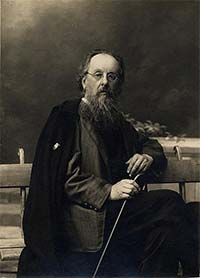 Adrian introduced us to Konstantin Tsiolkovsky (1857 – 1935.) As well as defining the rocket equation, Tsiolkovsky was the first to think about alternative ways of accessing space.
Inspired by the fiction of Jules Verne, Tsiolkovsky theorized many aspects of space travel and rocket propulsion. He is considered the father of spaceflight and the first person to conceive the space elevator, becoming inspired in 1895 by the newly constructed Eiffel Tower in Paris. It is said Konstantin Tsiolkovsky saw the Eiffel Tower and thought of keeping going.
Other scientists and inventors have also suggested or proposed other ways to get further to space and, perhaps, even to survive there
One of these was Yuri Artsutanov (1929-2019), born in Leningrad and a graduate of the Leningrad Technological Institute. He thought of "Into the cosmos by electric train" and its features - which describe the basic concept of the Earth Space Elevator today.
In the year 2000, NASA's Institute for Advanced Concepts (NIAC) commissioned Dr. Bradley C. Edwards to examine the reality of the space elevator. He reported phase 1 in Oct 2000 and then phase 2 in March 2003.
A space elevator is conceived as a cable fixed to the equator and reaching into space. A counterweight at the upper end keeps the center of mass well above geostationary orbit level. This produces enough upward centrifugal force from Earth's rotation to fully counter the downward gravity, keeping the cable upright and taut. Climbers carry cargo up and down the cable. It is a direct lift from the surface of the Earth up into space and back down again.
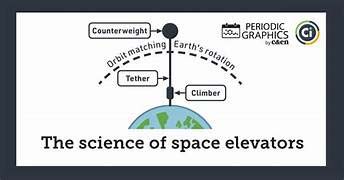
The elevator is based on solid foundations of science and engineering and will be the biggest civil engineering infrastructure ever created. This will be challenging to build. However, it is not impossible. All supplies and components need to reach the space station, and the challenge is overcoming the weight and stress involved.
Adrian concluded by saying Graphene would play a major part in the construction of the 'Stairway to Heavens'. The first of many questions from the audience was 'What if a plane crashes into it?' The proposed construction will be off the southwest coast of Africa where aircrafts don't fly over because of its location.
His talk was much enjoyed by our audience who gave a well-deserved round of applause.
Not yet a member? We're always delighted to welcome new members. Contact details: website at www.u3atod.org.uk or email at info@u3atod.org.uk.
Many thanks to Colin Sanson for this report
Previous U3A reports on the HebWeb - click here