

Sunday, 22 February 2026

The University of the Third Age meeting report
Life as a Roman Legionary
Speaker: Steve Welsh
The guest speaker at the u3a Todmorden Members Meeting on 19th February 2026 was Steve Welsh, with 'Life as a Roman Legionary'. Steve had visited Hadrian's Wall as a youngster many times and has walked the whole distance of it, wearing the full armour and clothing that legionaries would have worn.
He began his presentation wearing what looked like an oversized t-shirt and shorts, quite bravely given the time of year and recent weather. He went on to describe, and tell us about their uniforms and armour etc, by putting them on. His talk covered the time period of 100 to 200 AD.
Hadrian's Wall is a 73-mile defensive fortification built by the Roman Empire across northern Britain, beginning in AD 122 under Emperor Hadrian. It stretched from Bowness-on-Solway in the west to Wallsend in the east. It was constructed to act as a permanent, controlled border, separating the Romans from the "barbarian" tribes to the north and to regulate trade and movement, rather than solely as a military barrier.
The first challenge to be a Roman soldier was to survive childhood. Only twenty five percent of children born at this time survived into adulthood, due to disease, poverty and other factors. Women of childbearing age would had to have given birth to six to nine babies, because of the mortality rate. Another of the ways to keep the population of the Roman Empire up was making slaves of people from the countries and territories conquered.
The maximum age of the soldiers would have been about 35 years, but the officers could live into their sixties and seventies. All of the Roman Legionnaires had to be right handed, as defensive tactics included linking shields together using left arms, while fighting with swords and spears. They would have been paid twenty and thirty denarius per day, Steve said this would be roughly the same as pounds sterling today, and probably why men tried to become soldiers. They would also share out money and other valuables when conquering towns and cities – but only when they had battled with the defenders. If the occupants surrendered without a fight, the booty would be shared only by the generals, and other officers.
Steve wore, and described, the woollen tunic he was wearing, made of crushed wool with laminate. He had worn one of these on his long walk along Hadrian's Wall and it kept him dry and warm. He also demonstrated how a toga was worn, including tying it up with a knot behind his neck. The soldiers also had cloaks, again helping to keep warm. Legionnaires had to shave each day, until the time of the Emperor Hadrian, who allowed them to have beards.
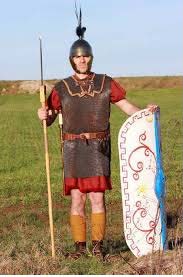 Moving on to the armour worn by the soldiers, Steve described the two main sorts by wearing each of them. They were clearly very heavy, and one of the sorts - Lorica Hamata (Chain Mail) was passed round the audience to test the weight. This had been made for Steve's son years ago, and much smaller than the ones the legionnaires would have worn but still quite heavy. We could imagine the weight of the vest that Steve, with some difficulty, put his adult size on. This sort of vest would resist blows from a sword up to an extent, but wouldn't stop arrows or spears.
The second example - Lorica Segmentata (Segmented Armour) would have been more effective against arrows etc, but was the least popular of the two types – the chain mail was relatively easy to repair and allowed greater free movement.
Steve had a life-sized representation of a Scutum; the iconic, rectangular, semi-cylindrical shield used by Roman legionaries, primarily from the 1st century BC to the 3rd century AD, designed to cover the body and facilitate the testudo (tortoise) formation. Weighing about 16 pounds, they were made of glued, laminated wood, covered in leather with a central metal bar.
Steve said that in a battle, the most dangerous things were stones. Frequently used with slingshots against Roman soldiers, they were hard to see and caused many casualties. The Emperor Julius Caesar actually made mention of the casualties and injuries caused by stones in his reports and memoirs. The short swords often used by Roman soldiers were called pugios, and again mentioning Caesar, he was thought to have been killed with such a weapon by his assassins. Senators and high-ranking soldiers were known to have carried pugios made of gold.
Julius Caesar reformed the Roman calendar to fix its misalignment with the solar year. The "Julian Calendar" contained two extra months – July to represent Caesar, and August for the Emperor Augustus.
The primary Roman sword was the gladius, a short, 18-to-24-inch stabbing weapon. It featured a double-edged blade optimized for close-quarters thrusting. The sword would be carried on the right-hand side of their body. This was because the left hand held the shield, and an awkward looking technique was used to draw the weapon.
An effective weapon used by the soldiers was a pilum. This was a roughly 2-metre long, heavy javelin or spear used by Roman legionaries, typically thrown just before close-quarters combat to break enemy lines. Its key design featured a long, soft-iron shank, about two feet in length attached to a wooden shaft. It was designed to penetrate, damage, or bend shields and armour, forcing enemies to discard their protection.
There would have been three lines of legionnaires attacking the enemy. The first line would launch their pilums and start to advance. The next line would then deliver another volley of pilums, and the third would do the same, and close quarter fighting would follow.
Steve described how the Roman helmets didn't cover the ears of the soldier, which helped with hearing orders and instructions from the officers. The helmets also had protection against sword blows to the face.
The discipline of the soldiers and their officers helped to sustain the fight with the enemy by replacing the front line when necessary, and allowing some rest to the soldiers before they again took their turn. Centurions commanded groups of eighty to a hundred soldiers and would have delivered orders during the battles and skirmishes. The Centurion always carried a stick, which was a badge of office, but was also used on the men for casual corporal punishment. Most Centurians died not through combat or war, but old age or disease.
Part of Steve's presentation was to compare the tactics of the Roman soldiers with those used by the police, particularly during the Miners' Strike in the 1980's. He showed images of the police formed up in ranks, some with shields, and the use of horses to break the lines of the strikers. Even today, news reports include footage of police and soldiers dealing with disorder and violence around the world in, often, a similar manner.
While telling us about the Roman soldiers, and their tactics and weapons, Steve had continued to put on the clothing, and representations of the armour, which looked like very hard work. But was an excellent way of delivering the information.
The presentation was very well received by the audience, and the applause given was much deserved.
Not yet a member? We're always delighted to welcome new members. Contact details: website at www.u3atod.org.uk or email at info@u3atod.org.uk.
Many thanks to Colin Sanson for this report
Previous U3A reports on the HebWeb - click here